
How a month comes together.
You tell us about one reader. Their people send photos and stories. We add reading chosen for what they follow, check every page, and mail a new issue every month.



Six steps from setup to mailbox.
-
Know the reader.
Ten minutes, once. Who it's for and where to mail it.
- Their name, and the name for the cover
- What they follow: teams, places, the work they did
- The dates that matter, and how it should sound
- Anything we should never mention. This list is private: never printed, never seen by a contributor.
-
Invite their people.
Only people you invite can send in.
Add family and friends by email, or share the magazine's invitation link. Start with five; add more any time.
Contributing is free. Texting or emailing needs no account; the web does.
-
Collect what they send.
Each week contributors get an email with one small thing to send.
By text Live
Text a photo, a few words or a voice note to (206) 864-5840 from the number you were invited with.
By email Live
Every magazine has its own address for contributions.
On the web Live
At app.paper-route.com, on a phone or a computer. Send to more than one magazine and choose which.
Voice notes Live
Record on the web, or send one by text or email. We turn it into words you can correct.
From an AI assistant Early access
Send from an assistant such as Claude. Available on request: hello@paper-route.com.
Google Photos Coming soon
Pick photos straight from your library.
-
Build the issue.
What their people sent, reading about what they follow, and something to go and do.
What their people sent, printed large, with a name under every face. Around it, reading written for what they follow: their team, their hometown, the garden in October. And a short list of things to go and do this month.
-
Prepare the magazine.
Laid out, then checked page by page.
Every page is checked against what you told us, including the never-mention list. The person who set it up sees a proof and can correct it before it prints.
-
Print and deliver.
A new issue every month, their name on the cover.
Twenty-four pages, one printed copy, mailed in the US early in the month. Past issues stay in the account of the person who set it up.
Voice notes become printed words.

Voice note, turned into words
Theo is two and has decided that every leaf in the park is his. He brought one home for each person at dinner.
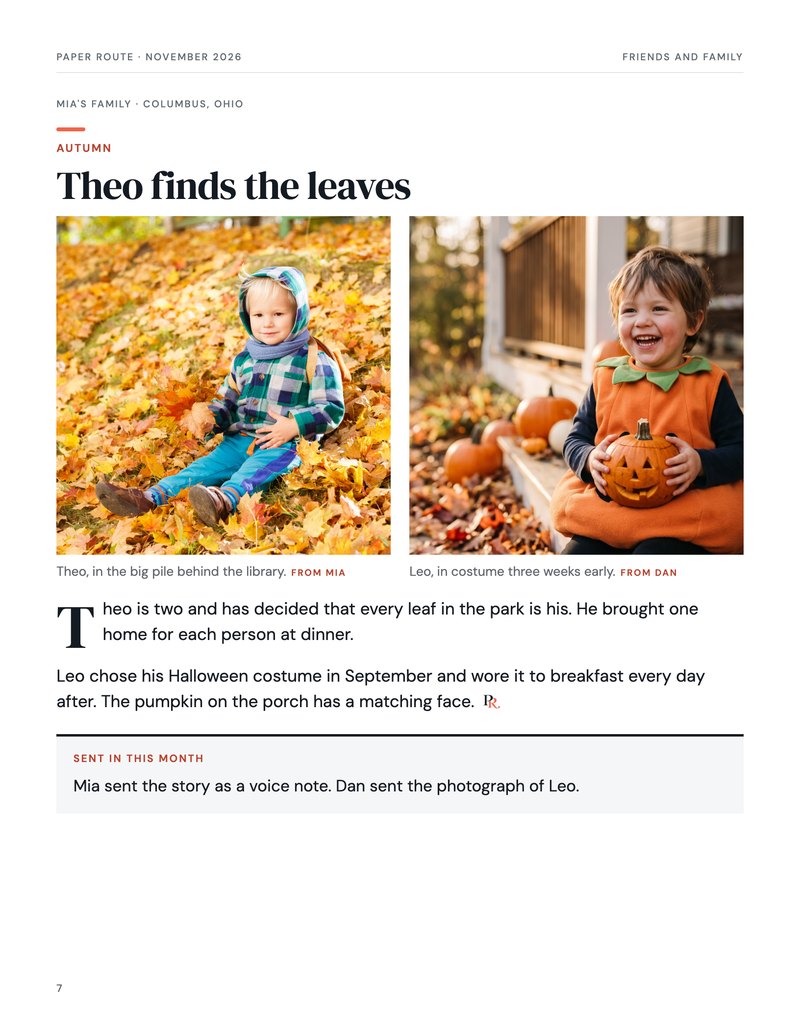
Sample page in the real print layout, with stock photography. The family is illustrative.
Where AI helps, and where it doesn't.
Real contributions.
- The photographs people send
- Their memories, news and own words, voice notes included
- Names, dates and relationships, from you and the sender
AI-assisted production.
- Setting people's words in the magazine's voice
- Drafting a caption from what the sender said, for them to change
- Interest pages: results from a sports data feed, hometown and news pages from what actually happened that month
It never invents a memory, never guesses who is in a photograph, and never presents an interest page as something a person said.
Why a magazine and not a photo book.
- Who makes it
- Photo book: you pick the photos and lay them out.Their people send, and we make it.
- What's in it
- Photo book: pictures of what happened.Their people, their world, and something to go and do.
- When it's done
- Photo book: when it prints.It isn't. Each issue picks up where the last one left off.
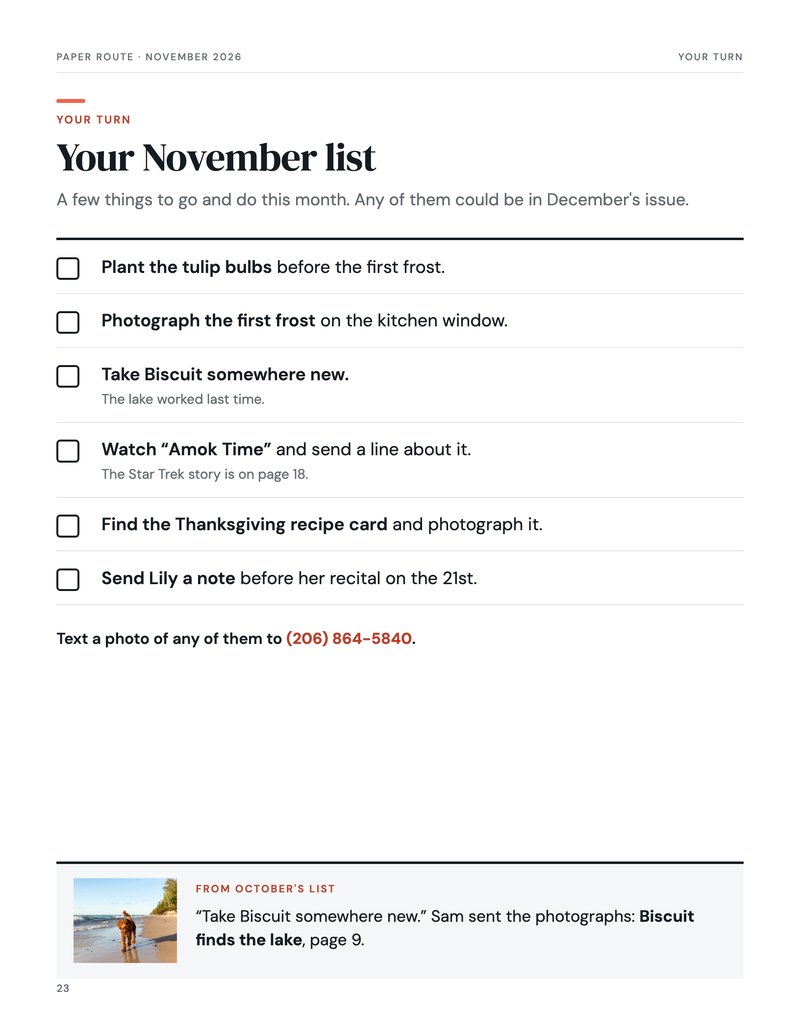
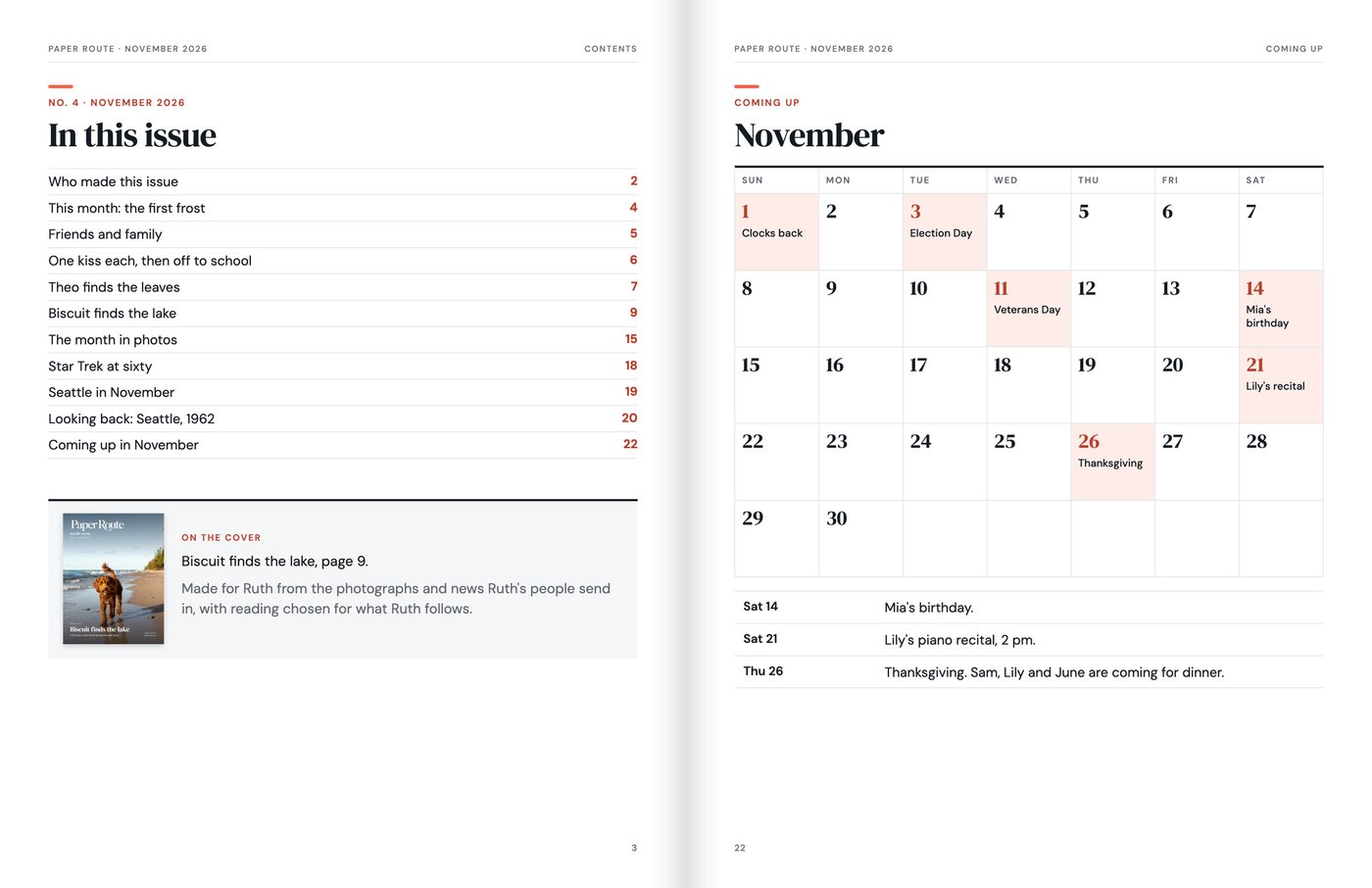
The magazine itself.
Twenty-four pages on matte paper, large type, a name on the cover. It stays on the table and gets read twice.
- The month in photos. What their people sent, printed large.
- Back home. One story from the place they came from.
- Whatever they follow. Their team, the garden, the fishing report.
- The month ahead. Birthdays, holidays, the games worth circling.
- Your turn. A few things to go and do, and last month's list answered.
Set up the first issue.
Tell us about the reader and invite their people. We write, check, print and mail each issue.

More questions? Read the FAQ.